
Python usage reference
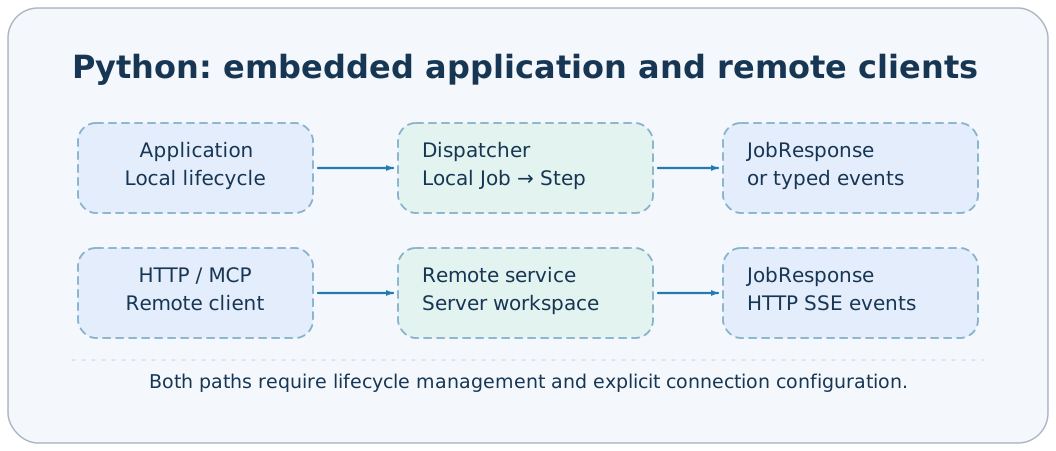
Python can embed an Application in-process or connect to a running HTTP/MCP service. Both paths return JobResponse, but differ in lifecycle, configuration, and execution location. This page uses the currently publicly exported classes and functions.
Import entry points
from axonx import Application, BaseStep, provider
from axonx.config import resolve_app_config
from axonx.components.client import HttpClient, McpClient, RemoteServiceError
from axonx.core import run_remote_job, stream_remote_job
from axonx.components.job import ResultEvent
Application is exported at the top level; HTTP/MCP clients and event types are exported from their respective subpackages. The project uses Python 3.12 syntax and cannot be imported directly with older interpreters.
Embedding Application
import asyncio
from axonx import Application
from axonx.config import resolve_app_config

async def main():
    config = resolve_app_config(log_config=False, config="default")
    async with Application(**config) as app:
        response = await app.run_job("version", {})
        if not response.success:
            raise RuntimeError(str(response.answer))
        print(response.model_dump(mode="json"))

asyncio.run(main())
async with starts components, Jobs, and schedulers in dependency order and closes them in reverse order on exit. This example does not start an HTTP listener; CLI start calls the service's run_app. Loading default composes its components, so their dependencies must be importable in the current environment. A minimal application can retain only the Jobs it needs.
Application does not automatically read .env; resolve_app_config expands only existing environment variables. If .env is needed, load it first using the application's own environment-loading approach.
Application methods
| Method | Parameters | Return and constraints |
|---|---|---|
| start() | None | await; idempotent startup |
| close() | None | await; cleanup in reverse order; multiple cleanup errors may be aggregated |
| run_job(name, arguments=None, *, target=None) | Job name, argument mapping, optional configured target | await returns JobResponse |
| stream_job(name, arguments=None, *, target=None) | Same as above | Returns AsyncIterator; do not await the method itself |
run_job and stream_job both require a started application. A nonempty target must appear in ApplicationConfig.targets and uses its address/token. Local calls are not restricted by HTTP public_jobs filtering, but business Schemas and reserved system fields are still validated.
HTTP client
import asyncio
import os
from axonx.components.client import HttpClient

async def main():
    async with HttpClient(
        target="127.0.0.1:1024",
        token=os.environ["AXONX_SERVICE_TOKEN"],
        timeout=600.0,
    ) as client:
        definitions = await client.run_job("get_task_definition", {"task": "demo"})
        if not definitions.success:
            raise RuntimeError(str(definitions.answer))
        submitted = await client.run_job("submit", {"task": "demo", "x": 1, "y": 2})
        if not submitted.success:
            raise RuntimeError(str(submitted.answer))
        handle = submitted.answer
        completed = await client.run_job("wait_task", {
            "task_id": handle["task_id"],
            "run_id": handle["run_id"],
        })
        print(completed.success, completed.answer)

asyncio.run(main())
Remote answer values are decoded dictionaries/lists; a local Application.answer may retain Pydantic/dataclass objects. For uniform processing, call response.model_dump(mode="json") first, rather than assuming answer has the same Python object type on both paths.
| HttpClient method | Key signature details | Return |
|---|---|---|
| run_job | name, arguments=None | JobResponse |
| stream_job | name, arguments=None | AsyncIterator[JobEvent] |
| list_jobs | None | list[JobInfo] |
| health | None | bool; failures map to false |
| copy_file | Path, filename=None, directory=None | FileCopy |
| discard_file | path: str | Cleaned-up path string |
Constructor parameters are target=None, timeout=60.0, and token=None; optional transport injects an HTTP transport, for example in tests. Calls are available only after entering async with. target must not contain /mcp or a Job subpath.
Consuming events
async with HttpClient(target="127.0.0.1:1024", token=token, timeout=600.0) as client:
    async for event in client.stream_job("stream_task", {"task_id": task_id}):
        if isinstance(event, ResultEvent):
            response = event.response()
            print(response.success, response.answer)
        elif event.kind == "log":
            print(event.content, end="")
This snippet belongs inside an asynchronous function; token/task_id come from configuration and submission results. See SSE for detailed framing and disconnection rules. Use contextlib.aclosing for asynchronous generators whose consumption ends early to ensure the event source is closed.
File upload
from pathlib import Path

async with HttpClient(target=target, token=token) as client:
    copied = await client.copy_file(Path("dist/axonx_example-0.1.0-py3-none-any.whl"))
    try:
        installed = await client.run_job("install_plugin", {
            "path": copied.path,
            "sha256": copied.sha256,
        })
        print(installed.model_dump(mode="json"))
    finally:
        await client.discard_file(copied.path)
This is an installation-flow snippet; confirm the artifact before executing it. copy_file reads and uploads in chunks; service-relative paths are not client file paths. Repeated discard_file calls can clean up staging locations already consumed.
MCP client
async with McpClient(target=target, token=token, timeout=60.0) as client:
    print(await client.health())
    jobs = await client.list_jobs()
    response = await client.run_job("list_task_ids", {})
    print(response.model_dump(mode="json"))
McpClient health uses MCP ping; list_jobs generates JobInfo from tool Schemas; run_job validates JobResponse from structured_content/data. It has no stream_job, copy_file, or discard_file; use HttpClient for live events and byte transfer.
One-shot remote functions
response = await run_remote_job(
    "version", {}, target="node-b:1024", token=token, timeout=60.0
)
async for event in stream_remote_job(
    "stream_task", {"task_id": task_id},
    target="node-b:1024", token=token, timeout=600.0,
):
    print(event.model_dump(mode="json"))
arguments is a required mapping; each call creates and closes an HttpClient. Use a long-lived client for frequent queries to avoid repeated connections. This target is a direct connection address and does not depend on the local Application's targets.
Errors and cleanup
try:
    async with HttpClient(target=target, token=token) as client:
        response = await client.run_job("status", {"task_id": task_id})
except RemoteServiceError as exc:
    print("Connection or protocol failure", exc.status_code, str(exc))
else:
    if not response.success:
        print("Business failure", response.answer)
Connection failures, HTTP rejection, and invalid envelopes/events raise RemoteServiceError; success=false within HTTP 200 must be checked separately. Local parameter errors may directly raise ValueError; exceptions within Steps are usually handled by the Job. Closing Application closes its task manager and may cancel managed workers, so a short-lived embedded application is unsuitable for submitting a task and exiting immediately.
Related documentation
Implementation references: axonx/__init__.py, core/application.py, core/dispatch.py, components/client/.