
Workspace and file-transfer API
Workspace Jobs handle directories, metadata, and data previews. File transfer uses separate HTTP routes to stage wheels and synchronization archives.
Calling conventions
All endpoints below use POST /jobs/{name} with a {"arguments":{...}} request body. For remote forwarding, add target at the envelope's top level, outside arguments. Every response uses JobResponse. Table defaults come from the current built-in configuration and Steps. Deployments may change Job Schemas; the running service's /jobs is authoritative.
All JSON examples illustrate structure; replace task IDs, session IDs, file paths, and hashes with values actually returned by your service. See Task contracts for the complete shared TaskStatus fields.
Endpoint list
| Job | Purpose |
|---|---|
list_entries | List one directory level within the workspace. |
list_task_runs | List task directories containing metadata.json. |
preview_file | Preview supported file types. |
delete_entries | Delete files or directories in the workspace. |
list_entries
List one directory level within the workspace.
| Parameter | Type | Required | Default | Constraints and meaning |
|---|---|---|---|---|
path | string | No | "" | Path relative to the service workspace |
Only the business fields listed in the table are accepted.
Request
{
  "arguments": {}
}
Response
answer is WorkspaceListing: path, entries, and truncated. Each entry contains name, path, kind, preview_kind, supported, size, and modified_at.
{
  "answer": {
    "path": "",
    "entries": [],
    "truncated": false
  },
  "success": true,
  "metadata": {}
}
Behavior and failure cases
path defaults to an empty string, representing the root directory; directories sort first. At most 5000 entries are returned. truncated=true indicates truncation; no offset pagination is provided.
list_task_runs
List task directories containing metadata.json.
| Parameter | Type | Required | Default | Constraints and meaning |
|---|---|---|---|---|
task_type | string | Yes | — (omitted) | Task type directory; minLength=1, regex ^[A-Za-z0-9][A-Za-z0-9_-]*$ |
Only the business fields listed in the table are accepted.
Request
{
  "arguments": {
    "task_type": "train"
  }
}
Response
answer has the same structure as WorkspaceListing, retaining only task-result directories.
{
  "answer": {
    "path": "train",
    "entries": [],
    "truncated": false
  },
  "success": true,
  "metadata": {}
}
Behavior and failure cases
Running or failed directories without metadata are excluded from the research-results list. task_type is a directory name, rather than a Task registration name.
preview_file
Preview supported file types.
| Parameter | Type | Required | Default | Constraints and meaning |
|---|---|---|---|---|
path | string | Yes | — (omitted) | Path relative to the service workspace |
offset | integer | No | 0 | Number of data rows to skip in CSV/Parquet previews; minimum=0 |
limit | integer | No | 200 | Maximum number of data rows returned in CSV/Parquet previews; minimum=1, maximum=5000 |
Only the business fields listed in the table are accepted.
Request
{
  "arguments": {
    "path": "base/base#demo#api-demo/metadata.json"
  }
}
Response
answer is discriminated by kind: text/markdown/json/yaml/csv/parquet/unsupported; every type includes size.
{
  "answer": {
    "kind": "json",
    "size": 1200,
    "content": "",
    "data": {},
    "parse_error": null,
    "truncated": false
  },
  "success": true,
  "metadata": {}
}
Behavior and failure cases
offset/limit apply only to CSV and Parquet data rows, default to 0/200, and have a maximum limit of 5000. text/markdown reads at most 512 KiB; JSON/YAML larger than 32 MiB returns parse_error. Parsing failure can still have success=true; always inspect parse_error.
delete_entries
Delete files or directories in the workspace.
| Parameter | Type | Required | Default | Constraints and meaning |
|---|---|---|---|---|
paths | array | Yes | — (omitted) | List of workspace-relative paths to delete; maxItems=200, minItems=1 |
Only the business fields listed in the table are accepted.
Request
{
  "arguments": {
    "paths": ["tmp/example.txt"]
  }
}
Response
answer is an array of DeletedEntry; deleted is a relative path and kind is file/directory for each item.
{
  "answer": [
    {
      "deleted": "tmp/example.txt",
      "kind": "file"
    }
  ],
  "success": true,
  "metadata": {}
}
Behavior and failure cases
At most 200 paths are allowed; the root directory and paths escaping the workspace cannot be deleted. Prefer delete_tasks for task directories to preserve task-status and log-management constraints.
Related documentation
Implementation references: axonx/config/default.yaml, axonx/steps/workspace/ and axonx/components/service/http/jobs.py.
File upload and cleanup
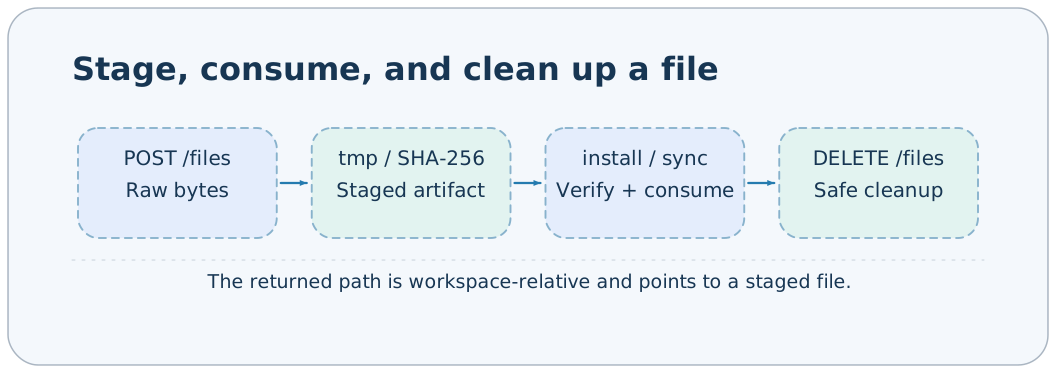
Upload using a raw binary request body, rather than multipart/form-data. x-file-name is a required filename header. Optional x-file-directory specifies a workspace-relative subdirectory beginning with tmp; it cannot target an arbitrary workspace location.
curl -s -X POST http://127.0.0.1:1024/files \
  -H "Authorization: Bearer $AXONX_SERVICE_TOKEN" \
  -H 'Content-Type: application/octet-stream' \
  -H 'x-file-name: axonx_example-0.1.0-py3-none-any.whl' \
  -H 'x-file-directory: tmp/plugins' \
  --data-binary @dist/axonx_example-0.1.0-py3-none-any.whl
FileCopy has the response structure below; use the actual returned hash and byte size:
{
  "answer": {
    "path": "tmp/plugins/aaaaaaaaaaaaaaaaaaaaaaaaaaaaaaaaaaaaaaaaaaaaaaaaaaaaaaaaaaaaaaaa/axonx_example-0.1.0-py3-none-any.whl",
    "sha256": "aaaaaaaaaaaaaaaaaaaaaaaaaaaaaaaaaaaaaaaaaaaaaaaaaaaaaaaaaaaaaaaa",
    "size": 4096
  },
  "success": true,
  "metadata": {}
}
Staging directories are named after the content's SHA-256; uploading identical content with the same filename is idempotent. The default per-file limit is 256 MiB. The service checks both Content-Length and actual streamed bytes. An invalid Content-Length returns 400; exceeding the limit returns 413. Missing/invalid filenames, directory escapes, and similar errors return 422; symbolic links or a destination occupied by different content return 409.
Consumers install_plugin and sync_tasks use the returned path. Installation also requires sha256. Completing an upload does not mean the plugin has been installed or the task snapshot applied. Consumers clean up staged artifacts; unconsumed uploads can be cleaned up explicitly:
curl -s -X DELETE 'http://127.0.0.1:1024/files?path=tmp%2Fplugins%2Fyour-digest%2Fyour-wheel.whl' \
  -H "Authorization: Bearer $AXONX_SERVICE_TOKEN"
The example path is a placeholder; replace it with the actual path. The cleanup response answer is {"path":"returned path"}. Repeated cleanup of a valid path already consumed is harmless. This route cleans only staged files and cannot delete arbitrary workspace files. Backend path rules reject absolute paths, escaping paths, and paths outside tmp.
Preview response types
| kind | Specific fields | Consumption guidance |
|---|---|---|
| text | content, truncated | Do not infer the complete file from truncated content |
| markdown | content, frontmatter, frontmatter_error, truncated | Read frontmatter separately and report its errors separately |
| json / yaml | content, data, parse_error, truncated | Do not analyze data when parse_error is nonempty |
| csv | columns, rows, offset, limit, has_more | Add the number of returned rows to offset for the next page |
| parquet | CSV-style fields plus column_schema, row_count, row_group_count | schema supplies column types and nullable |
| unsupported | size | The endpoint provides no preview content for this format |
Raw file size in bytes, row-pagination offset, and log-byte offset are distinct information. Text previews have no general character pagination. Parquet row counts and row-group information come from file metadata; returned rows represent only the current window.